Showing posts with label monish. Show all posts

Thursday, August 12, 2010

A Bug Called Shutterbug - 2

Here is the second attempt at making a book, but this time it is a flip book.

Do visit the below link to view the latest book and please provide your comments, critique and feedback.

A Bug Called Shutterbug – 2
Author – Monish Matthias
Type – FlipBook
Pages - 20
Category – Abstract, People, Wildlife, Nature
Date – 10 August 2010

Link to view (best viewed in firefox) the entire book - A Bug Called Shutterbug - 2

If you are using IE - use this link.

The Book download as a PDF can be found here.

ABCS2.JPG


PS: The first book link is here.


m.m

Friday, June 18, 2010

Is there a correlation?

Don't know if this is the effect of reading "Freakonomics: A Rogue Economist Explores the Hidden Side of Everything". It is a 2005 non-fiction book by University of Chicago economist Steven Levitt and New York Times journalist Stephen J. Dubner.

Scene out of the world

Case 1 - I have noticed this general scenario in India which includes me as well - Save more, Spend less - Save more for a happy future even if it means being Frugal now. The quote 'Save for a Rainy Day' is so commonly used in most of the households.

Case 2 - I have noticed many friends & other people (am guilty as well) - while eating a good meal we keep our favorite dish say fried chicken or a sweet dish for eating it at the end of the meal, we finish all the relatively ordinary dishes and then leisurely eat the relatively superior or tastier or favored dish.

Are case 1 & case 2 related? Do they have any vague correlation?

If I were to become the rogue economist and get into the shoes of Levitt or Dubner, I would say the following.

Analysis of Case 1 - yes the mindset in few countries are heavily biased over saving and not spending, it means you forgo certain pleasures of life at the peak of your health & early age and keep saving up for the future when you might not be able to utilize it to the maximum possible fun & happiness.

Analysis of Case 2 - yes the mindset in few countries are heavily biased over saving your best assets and not wasting / spending / using it rashly (or fast) [almost works on a principle of conservative rationing], it means you forgo tasting the best dish when you were really hungry (& could eat more) and keeping it for later times thinking you can enjoy it leisurely but the reality is by then your stomach is quite full and you end up just stuffing yourself and not relishing it.

Now do you get the correlation? There is a strong invisible mindset within most of us which influences most of our actions. Conclusion: The two cases have been proved to have a link.


"I always feel sorry for people who think more about a rainy day ahead than sunshine today." - Rae Foley

m.m

Sunday, April 11, 2010

Types of Innovation & Org Structures

Some pointers from The Ambidextrous Organization by Charles A & Michael L T – HBR

Some examples discussed – Kodak, Boeing, USAToday.com, Ciba Vision.

Types of Innovation

1) Incremental Innovations – Small improvements in existing Products and Operations.

2) Architectural Innovations – Technological or Process advances to fundamentally change a component of element of the business.

3) Discontinuous Innovations – Radical advances / breakthroughs that my change / alter the basis for competition in an industry.

Team / Org Structures

1) Functional Designs – Integrate project teams into the existing org and mgt structure. Ex – mfg, sales and R&D reports to a GM.

2) Cross functional teams – Operate within the established org but outside the existing mgt structure. Ex – mfg, sales and R&D reports to a GM, but a separate unit called emerging business cuts across mfg and r&d report to the respective unit.

3) Unsupported teams – are setup outside the established org and mgt structure. Ex – mfg, sales and R&D reports to a GM, but a separate unit called emerging business also reports to the GM.

4) Ambidextrous Organizations – Establish project teams that are structurally independent units each having its own processes, structures, cultures but are integrated into the existing mgt structure. Ex – mfg, sales and R&D reports to a GM under the division existing business, but a separate unit called emerging business which also has mfg, sales and R&D reports to the GM.

The difference in many are the path that they choose,

1) Exploitative Business

2) Exploratory Business

Their difference would lie in the factors – Strategic intent, Critical tasks, Competencies, Structure, Controls, Rewards, Culture, Leadership roles.


m.m

Tuesday, January 05, 2010

java.lang.OutOfMemoryError: PermGen space

We encountered the dreaded java.lang.OutOfMemoryError: PermGen space error


What does it means - Permgen Space is the space where the class files are all loaded for the first time and there after they are loaded or referenced from there. This error means there is a hell lot of duplicate classes being loaded and not all are being unloaded. These duplicate class instances are cluttering the permgen space and resulting in this error. One expects only only class instance of a java file. This is basically a memory leak.

Temporary Solution -
'start tag' jvmarg value="-XX:+UseConcMarkSweepGC" 'end tag'
'start tag' jvmarg value="-XX:+CMSPermGenSweepingEnabled" 'end tag'
'start tag' jvmarg value="-XX:+CMSClassUnloadingEnabled" 'end tag'
- These allow perm gen sweeping and allows class unloading, I guess it works really well when there is no memory leak but low perm gen space allocated, so when there is a space deficiency it automatically unloads few classes and then reloads them when needs. Yes there will be a performance issue but am sure not many will notice it.
'start tag' jvmarg value="-XX:PermSize=256M" 'end tag'
'start tag' jvmarg value="-XX:MaxPermSize=512M" 'end tag'
- you can keep increasing this value between 128 - 512 or more but this will only delay the time after which the error is thrown.

Tools - Few tools that I used for analysing this issue
a) MAT - Eclipse Memory Analyser Tool (Also recommended - has some great features to zero in on the suspect / culprit)
b) IBM Heap Analyser
c) JConsole
d) Yourkit - trial version for 14 days (you better solve your issue within 14 days :)) [Highly recommended - it allows monitoring and a hell lot of features]
e) JMAP


Analysis & Solution -
There are two ways of going about this, you would never programmatically create duplicate classes and load them into the permgen, so the only few options are
First Way
1) Are you using different classloaders or custom classloaders to load few classes? If yes there are cases that same classes are loaded often because of different classloader instances. Check you own code.
Second Way
1) Analyse the various frameworks that you are using, check in particular if you in your code or these frameworks use dynamic proxying, which means creating proxy classes at run time for loosely coupling the classes - http://java.sun.com/j2se/1.4.2/docs/guide/reflection/proxy.html
PS: A tip - check if any framework uses CGLIB, in my case it was this.

Approach 1
1) I used jmap on the unix machine and got the heap reproduced in a file called heap.bin.
2) Then open the heap.bin using the free tool IBM Heap Analyser (ha36.jar Let me know if you need it) or MAT or Yourkit.
3) Now you can view different details of the heap, like duplicate class, which objects is being created in large number or objects based on size etc.
4) Now go to class instances and search for duplicate classes or sort the classes by name and then go through the list.
5) You should be able to see at some point few duplicate classes being loaded and they would have different extension
example- Class ABC you can see Class ABC, Class ABC$$EnchancerByCGLIB$$9a6119f_32$$FastClassByCGLIB$$123456, Class ABC$$EnchancerByCGLIB$$9a6119f_33$$FastClassByCGLIB$$123453, Class ABC$$EnchancerByCGLIB$$9a6119f_34$$FastClassByCGLIB$$123454, Class ABC$$EnchancerByCGLIB$$9a6119f_35$$FastClassByCGLIB$$123455 etc etc
6) Now you know this class is being created by CGLIB / dynamic proxying and because they are all different classes all together they will be surely kept in the perm gen adding to the clutter and the error.

Approach 2
1) Yourkit attaches to the live running application - the process is given in their site.
2) Monitor the live application and keep checking the permgen and number of classes loaded and unloaded - if the classes loaded keeps increasing even after a threshold we know we are in trouble (jconsole also can be used to see the classes loaded and unloaded)
3) In your kit keep checking the class instances and search for duplicate classes or sort the classes by name and then go through the list.
4) You should be able to see at some point few duplicate classes being loaded and they would have different extension
example- Class ABC you can see Class ABC, Class ABC$$EnchancerByCGLIB$$9a6119f_32$$FastClassByCGLIB$$123456, Class ABC$$EnchancerByCGLIB$$9a6119f_33$$FastClassByCGLIB$$123453, Class ABC$$EnchancerByCGLIB$$9a6119f_34$$FastClassByCGLIB$$123454, Class ABC$$EnchancerByCGLIB$$9a6119f_35$$FastClassByCGLIB$$123455 etc etc
5) Now you know this class is being created by CGLIB / dynamic proxying and because they are all different classes all together they will be surely kept in the perm gen adding to the clutter and the error.
6) This list will only keep increasing as time flies / more requests are being processed.


Solution -
1) Now check which version of the framework you are using and check any recorded bug against it - I was using cglib-nodep-2.1_3.jar and it seems to have a weak reference to all the classes that it creates causing this clutter. I then had to upgrade Spring to spring 2.5.6.SEC01, Hibernate and CGLIB to their production stable releases.
2) After this fix / upgrade I took regular imprints / monitored it live and found there were no more duplicate classes being created.
2.1) Another way is to take regular heap imprints and you would see that there is pattern say heap1 = 10 MB, heap2 = 50 MB, heap3 = 100 MB, heap4 = 80 MB, Heap5 ~= 80 MB.
In the case of the error prone application / memory leak plagued application the pattern would be heap1 = 10 MB, heap2 = 50 MB, heap3 = 100 MB, heap4 = 120 MB, Heap5 = 140 MB....


PS: Jconsole can be used to see the heap growth, perm gen growth, class loading, class loading etc at run time. All the graphs can have peaks and downs but must even out in due course, if they keep going north then you know for sure you are going to have trouble.

Few More
jmap -permstat 18254 > permstats_2.txt
jmap -histo:live 18254 > histo_live.txt
jmap -histo 18254 > histo.txt
-XX:-TraceClassLoading Trace loading of classes.
-XX:-TraceClassLoadingPreorder Trace all classes loaded in order referenced (not loaded). (Introduced in 1.4.2.)
-XX:-TraceClassResolution Trace constant pool resolutions. (Introduced in 1.4.2.)
-XX:-TraceClassUnloading Trace unloading of classes.

m.m

java.lang.OutOfMemoryError: Java heap space

We encountered the dreaded java.lang.OutOfMemoryError: Java heap space error.
How often do we hit this error and look in bewilderment.


What does it means - Means there is a hell lot of objects being created and not all are being marked for GC. These stray objects are cluttering the heap space and resulting in this error. This is basically a memory leak.

Temporary Solution - start tag jvmarg value="-Xmx892M" end tag- you can keep increasing this value between 256 - 1024 or more but this will only delay the time after which the error is thrown.

Tools - Few tools that I used for analysing this issue
a) jmap -heap:format=b 12345 (unix)
b) jps - for pid in windows
c) jmap -dump:format=b,file=heap.bin 12345 (windows)
d) IBM Heap Analyser
e) JConsole

Analysis & Solution -
1) I used jmap on the unix machine and got the heap reproduced in a file called heap.bin.
2) Then open the heap.bin using the free tool IBM Heap Analyser (ha36.jar). Let me know if you need it.
3) Now you can view different details of the heap, like duplicate class, which objects is being created in large number or objects based on size etc.
4) Now there is a option to get the leak suspects, it would list a few leak suspects - it would surely list few open source frameworks like Active MQ, Hibernate etc which means you will have to upgrade these to the latest production release from the framework providers.
5) Concentrate on any leak suspect either on your classes or your packages or on any java's Class used a lot in your class.
6) I was able to find a wrongly declared and used variable related to threadpoolexecutor which was causing a lot of hanging objects. (key is to find the link between a leak suspect and the way it is related to your code)
7) After fixing this I took regular heap imprints and analysed them and found that the leak suspect was missing.
8) After this fix my application starting running for almost double the time but I soon hit the dreaded java.lang.OutOfMemoryError: PermGen space, about which I shall write in the next post.
8.1) Another way of seeing the success of your fix is to take regular heap imprints and you would see that there is pattern say heap1 = 10 MB, heap2 = 50 MB, heap3 = 100 MB, heap4 = 80 MB, Heap5 ~= 80 MB.
In the case of the error prone application / memory leak plagued application the pattern would be heap1 = 10 MB, heap2 = 50 MB, heap3 = 100 MB, heap4 = 120 MB, Heap5 = 140 MB....

PS: Jconsole can be used to see the heap growth, perm gen growth, class loading, class loading etc at run time. All the graphs can have peaks and downs but must even out in due course, if they keep going north then you know for sure you are going to have trouble.

Few more
jmap -permstat 12345 > permstats_2.txt
jmap -histo:live 12345 > histo_live.txt
jmap -histo 12345 > histo.txt
-XX:-TraceClassLoading Trace loading of classes.
-XX:-TraceClassLoadingPreorder Trace all classes loaded in order referenced (not loaded). (Introduced in 1.4.2.)
-XX:-TraceClassResolution Trace constant pool resolutions. (Introduced in 1.4.2.)
-XX:-TraceClassUnloading Trace unloading of classes.

m.m

Monday, January 19, 2009

Book? Author? Publishing?

Yeah, I am now an author of a book created and published by me with the help of blurb. It is a photography book, for which I have toiled a bit lately.

You can have a preview of the book and if you like it please do buy a copy.

The title: A bug called shutterbug
Subtitle: Biological eye vs. mechanical lens the war begins...

BOOK DETAILS

http://www.blurb.com/bookstore/detail/542361

Biological Eye vs....
By Monish Matthias


m.I.m

Wednesday, January 14, 2009

the inner beat...

The inner beat…

My journey to few countries in Europe in October 2008.

Europe had always remained a dream destination for me especially after reading Enid Blyton books when I was young, watching several movies filmed in London and Paris. Switzerland was completely out of my vision in the near future, only Roger Federer used to remind me of this place by his fascinating stroke play. I got lucky to come to the UK on an assignment for a short duration and after coming so close to many European countries, it’s a huge disappointment if you don’t get to visit your dream places. With all these thoughts running in my mind I started to search for some good tour agencies to get me going on a trip and that’s when I found out about Star tours, they were having a tour called the panoramic Europe a 5 day trip covering major destinations of Switzerland and France (Paris) and a little bit of Germany and Belgium. Hmm not at all bad for the price they quoted and the biggest bonus was that the Visa arrangement was taken care by them for a certain affordable fee and Indian food served on all days for lunch and dinner, who would want to miss nice Indian food after having cooked and toiled in the kitchen for the past few months trying to conjure some dish and appreciate it myself on a daily basis.
http://www.startours.co.uk/

The days started running quite fast since the day the tour was booked, lists were getting drawn left right and center, things to do, things to take, time to leave, things to book etc…This was a coach tour with around 2500 – 3000 km’s to be done in 5 days pretty much of road burning and seat warming to be done. As the day neared my excitement shot up like a thermometer exposed to the hot Chennai weather. The shopping was all completed a few days before departure, the taxi was booked for 4 am October 1st and rechecked once again much to the drivers irritation.

October 1st (the previous year on October 1st I was in Wayanad, Kerala – beautiful place) (Oct 2nd is still special :)) came rather soon / started early, I woke up 3 am and got ready and waited for the taxi, the driver decided to take revenge for my repeated reminders by coming late by 20 minutes and didn’t he make me feel like a heart patient whose blood pressure was shooting up like a race car speedometer which had just won the pole position. I went and picked up my colleague and his family, Dinakar, Rajeshwari and their daughter Kavya. We reached Wembley Park at around 5:30 and were waiting for the bus with chattering teeth as the morning temperatures are quite stingy and stay low at 3-5 Degrees (nothing in comparison with the -4 degree as I write). The bus came and we settled down and I was busy battling my claustrophobic demons of a closed bus, I get hyper whenever I am caged up and the windows and doors are not in my control…anyways got settled down in a bit and started dreaming of the many places that were to present themselves to me. Another funny incident that happened was, in the morning when I just got out after having a bath, it was so cold that I started shivering for a few minutes and I tried something funny to stop it and I sprained my neck so for the first few days of the trip I was looking like a crane with a sprain.

We arrived at Dover for the ferry crossing to Calais, France; we got into the ship and got settled into seats. We were in for a rough crossing the channel waters were choppy and so the ship decided to play to the tunes of the water and we were tossed up, down and sideways and at this point I imagined the plight of the vegetables tossed about in a fancy salad prepared in restaurants. Many of us made slow, measured trips to the rest room to donate our breakfast by puking, with all our heads dizzy we were left wondering if it was better to be under the heater in office. Finally we spent an extra hour in the ship and reached Calais and our stomachs were literally growling ‘grrrr’ with the horrors of hunger exposed to it. After a 10 minute drive we reached a services area where we were to have the first lunch of the trip. The tour agency has a separate mobile kitchen which cooks on the move and gets to the planned services a few hours before us and serve a nice aromatic hot meal, we had a good vegetarian lunch and started our journey to Belgium, slowly people in the bus started opening up, many were software engineers or related to the IT sector, some were from other sectors as well, many with their parents. We reached Belgium after 3-4 hours of a sedate drive and were late to visit the Mini Europe center so we had to be content with visiting the Atomium center and a little bit of the town and then we moved on to the night stay in a town called Thionville in France, we got there passing through Luxembourg, Belgium. I checked into room number 404 in a hotel called Kyriad, pretty decent room. We were famished by this time and got to the eating center and gorged on a tasty prawn curry etc…Day 1 over!

Ferry Starts - Dover to Calais


Atomium Centre - Belgium


Day 2
When I went to sleep last night I wanted to make sure I wake up on time and don’t get left behind in a strange town, my brains were on a over drive to make sure I don’t over sleep, I was sleeping and I suddenly woke up and looked at my watch and the time was 8:30, shit we were supposed to leave at 7:45, ok they have left without me what do I do, I look out and see that it is still dark, I drink some water and again check my watch, please note this time I look at it the in the right direction and I find out that its only 2:00 am and am safe ufff a sigh of relief and back to bed….(if you look at the watch / clock turned upside down you will notice 8:30 corresponds to 2:00)

Woke up again on time and got ready and had a hearty breakfast of croissants, juice etc and we started from there to travel through Germany and more specifically the black forests and then by evening get into the borders of Switzerland. The highways matched all the good highways found all over Europe and we were travelling peacefully and after a few hours we stopped in the middle of the black forests of Germany and I must accept this place was filled with beauty. Black/brown trees with snow at the top, apparently black forest cake derives its name from this region that’s why the cake is brown in color and has white icing at the top. We then had lunch and then proceeded to a cuckoo clock making factory and we had a tour of the ways with which they make clocks and must say such an ancient art can still make you stand up and take note of the precision that the nimble hands of these craftsmen provide. I was lucky to see one of the earliest clocks ever made dating back to 1640 and after gazing for a few minutes at the over the budget cuckoo clocks which have a delivery for any place in the world and a service center in almost any part of the world. We stopped at Lake Titsee for a photo session and the other motive was to get every one to warm their legs. This was again a beautiful lake in a scenic location. We started from there to get into the Swiss border and we passed through a good part of South Germany which has a good number of maize fields. We were finally stopped at the Swiss border and our guide and driver left us sweating without the engine running for a good 20 minutes which left us all angrily muttering under our breath. We started to Rhine falls and reached soon, we again carried our cameras and then formed the queue to board the boat which takes you to the base of the Rhine falls and you can clamber upwards to a good view point. It was a 5 minute ride to the other side and we reached the vantage point to see the furious & swelled up waters of the Rhine falls flow defiantly not being bothered by the presence of so many tourists or by global warming. Again a few photos and we waited for the boat to return and a few minutes later we were back to the bus and all ready to go the next destination.

We travelled for a while and then stopped for some chow and had some yummy Chicken curry and ordered some Argentinean wine and then we checked into the hotel which was situated in a hill kind of slope and the bus could get us only half way and we had to walk the rest, I moved into the room 419 in the Hotel Terrace in the town of Engelberg. An interesting fact is that it has a population of c. 4,000, of which 600 are of foreign nationality (2007). On the way we had passed through the city Zurich and we saw the river Zurich. The rooms in this hotel were like a playground wide, spacious and comfortable. End of day 2
http://en.wikipedia.org/wiki/Engelberg

Another Pose ...hmm - Germany AutoBahn's


In the middle of the Black Forests - Germany


Cuckoo Clocks


Rhine Falls - Switzerland


Rhine Falls - closer


Day 3

No midnight adventures like the previous night woke up and rubbed my eyes repeatedly as I was awestruck by the beauty that was seen from the window. The snow had just started that day for this season and the greenery from the previous season was still intact giving a combination of potent green and white art. Today was the big day as we were planning to go to the peak of mount Titlis a good 10000 feet high. Had a hearty continental breakfast and wore my thermals and got prepared for meeting the grail. After a 5 minute ride by bus we were at the base of the mount Titlis, where we were supposed to take the cable car to the peak. The last part of cable car way leads above the glacier Klein Titlis, and you could visit a glacier cave. Also this is where the world's first revolving cable car is present. With all this information we started the first cable car ride, we had to change at 2 stations and take 3 cable cars in total to reach the top of 3238 meters. http://en.wikipedia.org/wiki/Titlis The views were spellbinding, the snow on the tips of the trees as seen from the first cable car gave way to trees almost covered completely with snow, and the change at the second station was smooth. We saw many cows or yaks in the high altitude braving the cold and munching away what ever could be seen above the snow cover. The last stage with the revolving cable car was fantastic, standing at one place you get to see all sides as the floor rotates slowly (there is a revolving restaurant in Chennai - Carnival Heights Revolving Restaurant). It was something which I had never seen, whiteness as pure as milk spread over the entire distance viewable by my eyes. We reached the top and the temperature was hovering between -11 to -15 degree temperature and I really pitied the cable car operator and the staff working at that height. The world’s highest bar was present there and we had a glimpse of the place, we went into the glacier cave and then started warming up for the real fun – the real glacier. We had to rent shoes and we walked like explorers on the poles visualizing a saga of discoveries and wandering. It was white and white and white and snow flakes showering us, I have never felt this good in the presence of water or it’s by products. I was playing there for about 30 minutes, drenching my camera in the process and then finally got back under human conditions. We started the ride back down and we were treated to denser snow fall. We then left Engelberg and proceeded to the town of Luzern / Lucerne. Due to its location on the shore of Lake Lucerne within sight of Mount Pilatus and Rigi in the Swiss Alps, Lucerne is traditionally considered as a good tourist destination. One of the city's famous landmarks is Chapel Bridge (Kapellbrücke), a wooden bridge first built in the 14th century.
http://en.wikipedia.org/wiki/Lucerne
We visited the Bridge and the Lion Monument. Bertel Thorvaldsen's famous carving of a dying lion (the Lion Monument) is found in a small park just off Lowenplatz. The carving commemorates the hundreds of Swiss Guards who were massacred in 1792 during the French Revolution, when the mob stormed the Tuileries Palace in Paris.
After some souvenir shopping for Swiss knives in Swiss, we then moved to Interlaken http://en.wikipedia.org/wiki/Interlaken .
This is where the world famous the Jungfrau peak (4158m) and the nearby Jungfraujoch railway station (3450m) is present. I must accept that this is one of the most beautiful towns (in terms of scenic beauty) I have ever visited. Blue waters, beautiful trees, snow peaks, greenery in all sides, I could go on and on. We saw some adventure sports like Para gliding etc being practiced. We were roaming for an hour far away from the town center to see the real beauty of this small town and then crawled back to the town center to catch a look of the various shops present. We then started back to Engelberg and the entire bus members were playing dumb charades and antakshari – reminded me of school and college days, what I won’t give to return back to school days but of course minus the exams, punishment and my chemistry teacher. We had a nice Indian dinner with Italian wine and got back into the hotel packed and got ready for a few hours of sleep in Switzerland.
[Few things learnt in this trip] King / Emperor – Guess what’s the difference between a King and an Emperor? While many say a king is one who rules a kingdom and an Emperor is one who rules an empire. While that is partially right the main difference is King is usually elected by hereditary right, while an Emperor has won a war and taken over the ruler ship.

From the cable car - Engelberg


Snow tipped trees

Frozen


Me at the peak of Mt Titlis > 10,000 feet (-11 degrees)


View from the base of the cable cars


Me at Engelberg


The view near the Interlaken railway Station


Scenic Beauty - Interlaken


Adventure Sports at Interlaken


Beauty after life


Lion Monument - Luzern


Day 4

Got up, got ready, had breakfast, moved luggage to the bus. Today was the longest drive from Switzerland to Paris – they were hoping to make it less than 7 hours. Pretty boring, was looking out of the window most of time, reading the book Zillij by Ameena Hussein a Sri Lankan author. My best savior was the kid Kavya; she used to amuse me with her knowledge, playfulness, energy, innocence and what not…time used to fly while playing with her. We stopped at a service for lunch and then again resumed my sleep. I have a vague habit, when I am in any moving object I get the notion that someone is rocking me to sleep and I blissfully doze. As we got closer to Paris everyone started bickering over every tall building, every telephone / TV tower to be the Eiffel Tower and we did get a proper view when we got off for the very important cruise on the River Seine. The 2 hour cruise starts almost at the foot of the Eiffel Tower and moves on to cover almost most of the cities important places and goes under all the important bridges.

We were screaming and running around the boat looking at different scenes of the French life around us. We finally got off and were treated to good scenes of the sunset and the Eiffel Tower standing tall giving an additional aura to the great sunset. We got back to the Novotis hotel had a wash and a good chicken roast dinner and were off at 10 PM. where??? For a night tour of Paris, Paris the city of lights in night is bound to impress the tourist in you and not the environmentalist in you. Every building small or big, every lane crowded or empty was dazzling with lights. I heard that the EU was moving a ban on lighting of many building and the Eiffel Tower in the night after a certain time as several hundred thousands of Euros are spent every day on the electricity charges. We witnessed the Eiffel Tower in full glory in blue lights.
The places that we got to see during the boat cruise and during the night tour are the Opera house, the Arc of Triumph, Concorde Square, Parliament buildings, Sean de alleys (the magnetic street with people at all times), the tunnel where Diana met her sad end, the back entrance of the hotel from where Diana left, Old England hotel (the place where Lakshmi Mittal has one of the worlds most expensive marriage of his daughter), Louvre museum, Notre Dame, the royal hospital built with gold and a few of more buildings.

Paris the eternal city of lights where people don’t sleep seems so true only when you are standing right there with them. At 23:00 – 1:30 in the night you see all the bars, eat outs are having long queues for people getting in, the streets are crowded like in India with party goers, people just walking around meeting friends and what not…The true spirit of Paris.
[Few things learnt in this trip] Roads – If you see the roads and by lanes of Paris you would see that the structures are perfect and a small little curve would be accentuated well by the buildings in that curve, when you look ahead for a fair distance the stretch would be visible with no blind turns. Napoleon III took an active interest in the architecture and construction and was very strict in enforcing good quality.
http://www.arthistoryarchive.com/arthistory/architecture/Haussmanns-Architectural-Paris.html
And we returned by 1:30 AM early morning, with fluttering eye lids and memories of vivid lights, busy streets of Paris, wonderful lanes, rash drivers, beautiful architecture, people full of energy and life.


[Few things learnt in this trip] Church / Cathedral / Chapel / Basilica / Abbey– What is the difference?

A cathedral is the chief church of a diocese in which the bishop has his throne.

Basilica has an architectural sense (St Peters Basilica, Vatican City, Rome). The pope can declare a particular church as a basilica.

"Chapel" - A place of worship that has its own altar. The word itself is associated with the idea of relics, since it is drawn from the idea that St. Martin divided his cape (chapelle) in half and left half with a beggar.

"Church" A place for public (especially Christian) worship.

Abbey - A church associated with a monastery or convent.

The first encounter - Paris


The majestic bridges - Paris


Notre Dame Cathedral


Standing Tall


Sunset


Lights on - Showtime


Opera House


Day 5

Yes 4 days of my wonderful vacation have vanished, have made stronger vows of returning back to Paris on my own. We got ready and went to the magnificent structure of the Eiffel tower, we were going to conquer the tower and get to the topmost floor of the structure. The tower is the icon of Paris, it is an iron structure, the tallest standing building of Paris, the most visited paid monument in the world, 1,063 ft high. It was built for a world fair to be demolished later but as it supported and worked as a good communication tower it was left to stand. They use 50 -60 tonne’s of paint every year to keep the structure rust free. The top of the tower moves up to 7 cm’s when there is a heavy wind blowing. Upon the Nazi occupation of Paris in 1940, the lift cables were cut by the French so that Adolf Hitler would have to climb the steps to the summit. When visiting Paris, Hitler chose to stay on the ground. It was said that Hitler conquered France, but did not conquer the Eiffel Tower. Another interesting story was that novelist Guy de Maupassant — who claimed to hate the tower — supposedly ate lunch in the Tower's restaurant every day. When asked why, he answered that it was the one place in Paris where one could not see the structure.
http://en.wikipedia.org/wiki/Eiffel_Tower

[Few things learnt in this trip] Picnic – The origin of picnic is from a French word pique-nique- for more details click here http://word-powers.blogspot.com/2007/08/word-powers-friday-fiesta.html

Coming to day 5 we stood at the base of the tower clicking away pictures, and to our sorrow we discovered the top most floor was closed due to the reason that the wind was so strong up there and could blow people off. So we had to contend ourselves with a visit to the second highest floor. We had to squeeze ourselves in an ancient OTIS lift which to my discomfort has been there from the past century. I was praying that the lift doesn’t decide in my presence to make a call to the mechanics. Hopefully we got up in quick time and had great views of the city and that’s when you realize that the Paris is indeed built with great precision and planned well – the roads and lanes are well cut and the city presents itself as being very organized. After clicking away to glory to the discomfort to my S3 IS camera we started our descent via the great steps of the tower 340 steps to the second level and 328 steps to the first level. We then went around the city center and then started our journey back home after 5 days of touring places, we got back to Calais and crossed the ocean which was in a better mood and did make us run to the rest room often. We reached East Ham at 9:30 and caught a series of tube, train and taxi and got home by 12:30 – 1:00 to end a fantastic, fascinating and fantabulous holiday. Though I had to wake up at 6:00 the next day and get to office by 8:00 and make up for my absence, nothing can beat the effort and the trip. Have a look at the pictures below.
The Main Foundation


The Welled Planned City of Paris - 1


The Welled Planned City of Paris - 2


The View from the first level of Eiffel


For more pictures - http://www.flickr.com/photos/minmaxmim/


m.I.m

Wednesday, December 31, 2008

Wild thoughts of MiM! - Part 4

Another one of my wacky / tacky thoughts / joke

Mom: Children come and taste the dinner that I have made, its a lovely new recipe, I am sure it will take you to heaven.

Children: (Amidst groans and grins) - mom incidentally or coincidentally the last time you said the same thing we landed in the hospice / clinic / doctors place called heaven... :)

Apologies if you didn't laugh. Anyways laugh your way into 2009 Wish you a happy and prosperous new year.

Click on the picture to have a clear view
http://www.flickr.com/photos/minmaxmim/3152711077/


Wild thoughts of MiM - 1
Wild thoughts of MiM -2
Wild thoughts of MiM -3

Photography - http://www.flickr.com/photos/minmaxmim

m.I.m

Sunday, December 21, 2008

The Art Of Being Happy

An article written for the Adarshan Bangalore Magazine...

Read it and be happy...

Wish you all a very merry X Mas and a prosperous and happy new year 2009!

THE ART OF BEING HAPPY


Disclaimer: These are purely personal views and might not be agreeable to all.


While each man is free to choose his own I like the art of being happy the most.

While pondering over topics on which I could write for this magazine,
Amongst the many suggestions that came to my mind were articles on the economic gloom, the horrendous situation in Zimbabwe, the inexplicable terror attacks in Mumbai, then when I asked few people for suggestions they said anything is fine as long as it is happy. Now this set my mind racing - why does our mind seek all the negative energy in the world rather than merely enjoy the beautiful things out everywhere around us.

As my quote goes
“99% of the time one needs to be happy and the remaining 1% needs to be spent in preparing to be happy” – MIM

If only we remembered that we are just transient passengers in this huge journey called life why waste our limited time to being unhappy and down? Our life span vs. life of the world is comparable to 1 sec vs. the seconds available in one year (1 vs. 31536000). Similarly our life time is such a small part of the larger picture that we just can’t waste time by being unhappy or depressed.
There is a whole world of difference between being sad and unhappy. The opposite of a happy person is not a sad person but is an unhappy person. It is not so that a happy person cannot ever be sad or depressed but this state is transient and will disappear soon. But an unhappy person will find it terribly difficult to find happiness and will make it conditional: I will be happy ONLY when /if and so the list goes on.

While being sad is not a crime- indeed being sad is also an emotion that every person must experience. The feeling of sadness is in fact a complimentary phase of happiness, the very need of one being happy is because one doesn’t want to be sad. But being unhappy is a crime.

Happiness is a mental objective; it requires the power of imagination. You have to imagine yourself as being happy in order to be happy, and yes, you just can’t wait for happiness to come to you. There is no magic potion to harness happiness within you and for others.

"The art of being happy lies in the power of extracting happiness from common things."
-- Henry Ward Beecher

Some of us are in a happy state while shopping, some while writing, some while taking photographs, some while gardening, some while sleeping, some while eating. We should however remember that there is a very small line between addiction and (responsible) happiness. I can’t claim to be happy only while I snort ten big lines of cocaine.

In times of economic woe such as these we need to be prudent, but real sense prevailed in me when I absent mindedly understood the lyrics of a Tamil song from the movie – Pudupettai – it translates to mean,
“….what’s the point in saving up all your money without even enjoying a bit of it, tomorrow suddenly if you leave the world what’s the whole point? ….”

When I look at certain countries with so many different kinds of issues and worries, I can never claim the luxury of being sad and ever complain about anything When people in Zimbabwe are eating the cow skin which was part of their 100 year old flooring, how can you and I ever complain this is not right, that is not right, I don’t have a good life etc?

Here are few basic happiness maintaining techniques
1) Decide to be Happy: No one else can take this decision for you.
2) Happiness should be a priority: Like you plan for your ambition, savings, growth etc you must plan for your happiness.
3) Path to happiness: There will be many a times when you are down, disinterested and feeling sad, don’t let this state prevail more than 5 minutes start counterattacking the sad thoughts, start questioning the real reason of those facts, start working around them to find out the way to overcome the sorrow and get happy. When you are positive, good things happen to you, when you are negative; you draw bad things to you.
4) Constructive energy: Rather than lose all energy by being down, raise your bar and focus all the doom and gloom to find unique ways to counter attack the problem.
[For 3 and 4 – in terms of thinking out of the box and other innovation techniques– try to define at least 10 solutions to any problem and then only choose one. This is because the human tendency is to always choose the first easily achievable solution which comes to ones mind]
5) Dream about happiness: The first step to achieve anything is to think more and more about it, dream it and achieve it. The brain apparently moves towards working out happy dreams in a faster manner.
6) Be appreciative: By just appreciating the wonderful small things around you, you can be very happy. Example if you see an spider which has built a huge web in your house don’t start screaming and calling commands for people to clear it, rather watch the intricate design of the web, take photographs appreciate the little ones hard work etc and then decide what you want to. By being appreciative you also tend to spread positive energy around, you appreciate one person he is in a better mood and appreciates some one else and the cycle just goes on.
7) Forgive and Forget: This doesn’t need any explaining and is very important for being happy.
8) Spread happiness: Try spreading the joy of happiness by means of social or financial contribution to the needy. Volunteer to read for the blind, to take classes for the poor children.
9) Believe in yourself and a higher spirit: Having a high self confidence and indulging in prayers usually works as great stimulant for happiness in many people.
10) Happiness is infectious: This has been proved scientifically that happiness grows in leaps and bounds when in the presence of happy people and good locations. Draw up a list of 5-10 things that make you happy, it could be watching you tube clips of tom & jerry or it could be viewing your photograph collection. Whenever you feel down or out run through the list and within minutes you are freed of your sadness.

One of the jokes I remember from my school days is
WHY STUDY?
Why study? You study to learn more, the more you learn, the more you know, the more you know, the less you can store, the less you can store is the less you know then why study…

Similarly
WHY TO WORRY?
Why to worry? The more you worry the more tension you get the more tension you get, the more unhappy you are, the more unhappy you are, the less of happy you are…so beware…

Let me wrap up with some interesting quotes
“Happiness is not the absence of problems but the ability to deal with them.”
-- H. Jackson (Jack) Brown Jr.

“The reason people find it so hard to be happy is that they always see the past better than it was, the present worse than it is, and the future less resolved than it will be”
-- Marcel Pagnol

Happiness is when what you think, what you say and what you do are in perfect harmony. -- Mahatma Ghandi

Don't live `for' happiness. Live `with' happiness". -- Indian Philosophers

Be happy and spread the joy of happiness, treat yourself for this wonderful year 2008 and enjoy the run up to a lovely Christmas and let’s hope and pray we have a even better and prosperous new year 2009. Wish you all good luck.


Monish M


m.I.m

Friday, August 15, 2008

Takeaway from the movie - WANTED

I hope that you are not hoping against hope that Angelina Jolie would be the hopeful takeaway, but that's practically quite hopeless, and that's not the point that I want to hope to convey here :)

James McAvoy in one of the opening scenes of the movie 'Wanted' works in a job almost similar to an IT engineer and he says...

"my doctor says I have RSI, can you imagine what a horrible and boring life it is, where one gets to do only repetitive work and gets injured too"


Might not be the exact words, but hope I have caught the essence.


http://www.flickr.com/photos/minmaxmim/2553500395/

m.
I.m

Wednesday, August 13, 2008

Cooking tales...Series 1

Of late I have been cooking various dishes,
Have a look -
http://www.flickr.com/photos/minmaxmim/sets/72157606704871091/


My cooking tales are going to involve some interesting facts or goof ups...

Goof up 1 - date 12 - 8 - 2008
I had bought raw plantain to make a nice spicy sabji - vallakai kootu, the kootu became a kootooo....
Yesterday as I unpeeled the 'Green' peels thinking that being green ensured that the plantain would be quite raw, but as the plantain shed more of its outer clothing in a seductive manner, my nostrils were treated to a nice bananaish smell, never have I ever smelled a raw plantain... as the clothes go off, I mean the peels go off I am able to see the pulp of a slight yellowish color. As my doubts starts traveling towards north, I decided to taste the pulp and it was so sweet and yummy that I devoured it instantly and there ended my aspirations of making vallakai kootu. Might sound silly but not to me who was dreaming of a spicy side dish for a few hours before this goof up. So till I meet the proper raw plantain my cooking of this particular dish is indefinitely postponed.

m.I.m

Monday, June 30, 2008

Wimbledon – A real reckoner ready.

This reckoner is based with a lot of help from my memory and work put in to attend the Wimbledon / The championships on 28th June 2008 – Saturday.

What is Wimbledon?

There are two answers to this.

Answer 1: Wimbledon (pronounced /wImbaldan/) is a suburb of London, part of the London Borough of Merton and located 7 miles (11.3 km) south west of Charing Cross(another place close to London Waterloo). For most of the past one hundred years, Wimbledon has been internationally known as the home of the Wimbledon Tennis Championships.

Etymology: The name Wimbledon means "Wynnman's hill", with the final element of the name being the Old English dun (hill). The current spelling appears to have been settled on relatively recently in the early 19th century, the last in a long line of variations. The village is referred to as "Wimbedounyng" in a charter signed by King Edgar the Peaceful in 967 and is shown on J Cary's 1786 map of the London area as "Wimbleton".

Wimbledon was not only famous for Tennis but also for football – Wimbledon football team which won the FA cup against Liverpool in 1988, but with teams like Chelsea and Fulham rapidly developing in close proximity saw this team decline rather rapidly.

Sir Joseph Norman Lockyer - English scientist and astronomer; joint discoverer of helium was one of the famous resident who has resided in Wimbledon.

Accessible by: Wimbledon station train, Wimbledon tube, Wimbledon bus.

Credits and for more information, my memory & http://en.wikipedia.org/wiki/Wimbledon%2C_London

Answer 2: The Championships, Wimbledon (commonly referred to as Wimbledon) began in 1877 and is the oldest tennis championship in the world (four years older than the US Open). Wimbledon is one of the four Grand Slam tennis tournaments.

The tournament is held in the London suburb of Wimbledon, England, at The All England Lawn Tennis and Croquet Club. It is held annually from late June to early July. The tournament is calendared so that it ends on the second Sunday of July and begins on the Monday, 13 days earlier. It is the third Grand Slam tournament played each year.

Surface: It is preceded by the Australian Open, which is played on hard courts, and the French Open (Roland Garros), which is played on clay courts. It is followed by the U.S. Open, which is played on hard courts.

The Championships were first played under the control of the All England Lawn Tennis and Croquet Club in 1877 at a ground near Worple Road, Wimbledon; the only event held was Gentlemen's Singles. In 1884, the All England Club added Ladies' Singles and Gentlemen's Doubles. Ladies' Doubles and Mixed Doubles were added in 1913. Until 1922, the reigning champion had to play only in the final, against whoever had won through to challenge him. Championships moved to their present location, at a ground near Church Road, in 1922. Britons are very proud of the tournament, though it is a source of national anguish and humour – no British man has won the singles event at Wimbledon since Fred Perry in 1936, and no British woman since Virginia Wade in 1977. The Championship was first televised in 1937.

The first Sunday is always considered to be a rest day, but if rain has disturbed any of the previous day’s matches, then on each of these occasions, Wimbledon has staged a "People's Sunday", with unreserved seating and readily available, inexpensive tickets, allowing those with more limited means to sit on the show courts. Additionally, if the tournament is not completed by the end of the second Sunday, all remaining matches are postponed until "People's Monday".

Wimbledon historian Richard Milward recounts how King George V opened the new courts. "He gave three blows on a gong, the tarpaulins were removed, the first match started - and the rain came down..." The club's old grounds continue to be used as the sports ground for Wimbledon High School.

Credits and for more information, my memory & http://en.wikipedia.org/wiki/The_Championships,_Wimbledon

How many courts are available and what are the premier courts?

There is a center court, then courts 1-19. Center court, Court No 1 and Court No 2 are the premier courts.

What are the various ticket categories?

There are 4 varieties of tickets,

a) Center court – The most sought after ticket which allows entry and seating into/in the center court and then unreserved standing in the Court 2 and free access to Court 3-19. This ticket doesn’t allow you in Court No 1.

b) Court No 1 - The second most sought after ticket which allows entry and seating into/in the Court 1 and then unreserved standing in the Court 2 and free access to Court 3-19. This ticket doesn’t allow you in Center Court.

c) Court No 2 - The third most sought after ticket which allows entry and seating into/in the Court 2 and also unreserved standing in the Court 2 and free access to Court 3-19. This ticket doesn’t allow you in Center Court and Court No 1.

d) Ground passes – The only tickets which are obtainable by many people visiting the Wimbledon. It allows entry in the unreserved standing in the Court 2 and free access to Court 3-19. This ticket also allows you access to the Henman’s Hill.

How to buy tickets?

Many would think…What a stupid question; buy it like you would buy any other sporting ticket from specified centers, from online websites. THAT’S RIGHT AND WRONG! There are some different set of ticket buying rules that apply to the Wimbledon.

1) Debenture Tickets: These are the only Wimbledon tickets that can be transferred legally; all other tickets must be used by the original applicant. These are in the close range of 250 – 3000 GBP which is 20000 – 2, 40,000 INR. These can be bought from many online stores and other places. http://www.aeltc.com/cms/debentures/

2) Partners / Affiliated Organisations / Agents Tickets: There are certain quotas of tickets which are given to affiliated organizations to distribute to their members and the agents can sell it to their corporate clients or various other uses.

3) AELTC Public Ballot Tickets: Every household can apply for the draw of tickets of the premier courts. This only ensures a chance to be part of the draw to get few tickets from the draw. But members can’t decide day, time and place as this process is computerized. The application for next year’s ballot would be given out in the month of August.

4) Queue Tickets: The most interesting ticket ever possible. It gives every trier a fair chance to get a premier court ticket or a chance to get a ground pass. Will explain this in detail ahead.

5) Resale Tickets: Godsend option for the center court, premier court lovers. Will explain this in detail ahead.

If some decides to become generous they can also hand over their premier court tickets to you and leave.

Queue Tickets: For getting a chance to get the premier court tickets or to get the ground pass, one has to queue up. The tickets counters open at 10:30 every morning. If you really want a chance of the premier court tickets you will have to start queuing up on the previous day around 6:00 in the evening. This was achieved by camping on the pavements etc. From this year they have been allowed access to camp in the Wimbledon Park. So you can bring your own camp, sleeping bags etc and camp in the night, in the morning at 6:00 the stewards will wake you up and get you to remove your cars and remove the tents. I have heard that if you are in the top 300 – 500 you will get a fair chance to get the premier court tickets. Then on the day of the event, from 3 – 4 AM, people start coming to queue in the car park 10 / Wimbledon park, they also join the main queue. I left home by 6:00 in the morning and was there in the queue by 7:00 only to be dazzled by the number of snakelike queues, and immediately knew I was in for a worse than a roller coaster ride before I buy the tickets. The only beauty is it’s so well organized that it’s not a painful experience rather it lets you soak yourself in the Wimbledon tradition. As I sleep for an hour and by 8:30 the queue cards were given. Queue cards are a way by which they make sure you don’t reserve place/space for anyone else rolling in sleepy pleasures back home. My number was 4844 for all my best efforts of getting to the ground early. Anyways I had read somewhere that up to 6000 there is a very good chance of getting the ground passes. After getting a bit bored again I clicked a few pictures in the Wimbledon lake close by and joined the queue fast, because one should not be missing from the queue for a long time though no one bothers once given with a queue card. Then the slow moving of the queue bought joy to many once to realize quite soon that they were just being given some stretches and activity by the Stewards there, we moved from xx longitude to xy longitude. Another small snooze from moi and I joined some locals who were playing ball catches. Must bring to these queues are water, snacks, playing cards, books, paper to sleep/read, games etc.

Then by 11 we were finally in the security check area and then presto you are at the gates of the Wimbledon – ticket area, Sir one ground pass please…thank you…wow the Wimbledon arena. Magnificient!

The cost varies on each day.

People had started queuing for Monday’s match tickets on Saturday morning a cool 48 hours before.

Queue pictures


Queue Card with Mahesh Bhupathi's Signature

Ground pass

TODO: There is a central board across the entrance where the entire days draw is listed, you must make take a pen and note down which all matches you would like to watch, and ideally you can watch 4 short matches or 3 matches which are well fought out.

My match list along with the scores is as follows,

1) Gentlemen's Singles - 3rd Round – Court 3

Rainer Schuettler (GER) def Guillermo Garcia-Lopez (ESP)

6-2 6-3 6-4

2) Ladies' Doubles - 2nd Round – Court 4

Bethanie Mattek (USA)/Sania Mirza (IND) def Maria Kirilenko (RUS)/Flavia Pennetta (ITA)

6-3 6-4

3) Gentlemen's Singles - 3rd Round – Court 2

Mikhail Youzhny (RUS) def Radek Stepanek (CZE)

7-5 6-7(5) 6-4 6-7(4) 6-3

4) Ladies' Doubles - 2nd Round – Court 3

Akgul Amanmuradova (UZB)/Darya Kustova (BLR) def Anne Keothavong (GBR)/Melanie South (GBR)

6-4 4-6 7-5

5) Gentlemen's Singles - 3rd Round – Court 11.

Marin Cilic (CRO) def Paul-Henri Mathieu (FRA)

6-7(5) 6-3 6-4 7-6(6)

6) Mixed Doubles - 2nd Round – Court 19

Igor Andreev (RUS)/Maria Kirilenko (RUS) def Mahesh Bhupathi (IND)/Sania Mirza (IND)

7-6(4) 6-3

7) Gentlemen's Singles - 3rd Round – Center Court

Rafael Nadal (ESP) def Nicolas Kiefer (GER)

7-6(3) 6-2 6-3

It was a mixed day for India with Sania winning the ladies doubles, but losing in the mixed doubles with Bhupathi, and Paes losing in the mixed doubles too.

Resale Tickets: Now many of you reading this with a little bit of attention would notice that my list of matches also holds a star match of the center court, how did I with a ground pass get to watch this match. Yes by buying a resale ticket. When premier court ticket holders decide they have had enough and would like to get back home have an option of turning in the tickets at the counter which are processed again and resold again as resale tickets. These are priced at 5 GBP. What a steal, a ticket which could have cost 3000 GBP coming to you at 5 WoW. As we were watching Bhupathi and Sania lose we decided we will try for these tickets and we did get some real fast. I got one of the seats in the A row accessible by the P entrance, that’s the first row of the court, pretty close to Nadal and Kiefer, luck played a major role. Else you would get some very good seats too.

The best part of this concept is that the monetary funds go towards charitable causes. Whoa bravo effort.

Center Court ticket


Highlights:

1) Watching Rainer Schuettler GER who had won over James Blake in the second round.

2) Watching Sania Mirza win the ladies doubles match.

3) Watching R Stepanek and M Youzhny battle it out.

4) Watching Cilic score some cracking forehands.

5) Watching Anne Keothavong play well.

6) Watching B Bryan battle it out.

7) Getting an autograph from Mahesh Bhupathi.

8) Seeing Tim Henman.

9) Seeing Jelena Jankovic.

10) Seeing R Bopanna.

11) Seeing Alan Wilkins

12) Watching Nadal steam maul Kiefer badly. Kiefer played superbly though. Nadal is raising his game to new standards.

13) Watching the live challenges on center court, the Mexican wave etc.

14) Hearing Sania’s mom egg her on.

Must do’s and Tips:

1) Be early – worth the wait for at least few times.

2) Carry snacks for the queue.

3) By 5:00 in the evening be on the continuous watch out for the resale tickets.

4) Visit some of the premier courts.

5) Visit the Graveyard of courts - Court No 2, which has been dubbed the "Graveyard of Champions" due to its reputation as the court on which many seeded players have been eliminated during the early rounds. Famous players who have lost on the Graveyard during early round play include Joe Creedon, Ilie Nastase, John McEnroe, Boris Becker, Andre Agassi, Pete Sampras, Martina Hingis, Venus Williams, and Serena Williams.

6) Visit Henman hill - at the northern end of the grounds there is a giant television screen on which important matches are broadcast. Fans watch from an area of grass officially known as the Aorangi Terrace, but more commonly called Henman Hill. The "hill" takes its name from local favorites Tim Henman, who many fans once hoped would become the first British man to win the tournament since Fred Perry did so in 1936. Now they are watching on it for Andy Murray.

7) Eat Strawberry and Cream for the spectators, strawberries and cream is the traditional snack at Wimbledon. Approximately 28,123 kilograms (62,000 pounds) of strawberries and 7,000 litres (1,540 gallons) of cream are sold each year during the Championships. Strawberries are the only fruit which have it's seeds on the outside.

8) Another secret tip is if you want to watch any match in court 2 grab the last row seat of Court 3 as you can turn back and stand and watch the Court 2 proceedings with a clear view.

9) Similarly for court 19, you can view it from court 18 left most side.

10) You can also visit the Wimbledon shop or the Museum if you wish.

11) Take your camera; remember flash photography is not allowed.

12) Take the Wimbledon shuttle from the tube or station as it’s a time saver and helps in getting ahead by at least 500 positions in the queue. Try not walking because in most likeliness you would be standing for the major share of the day.

13) Take cash as cards are not accepted at the ticket counter.

14) Take a hat, cap, shades, sun screen and an umbrella would be quite helpful.


The quotation that meets each player while entering in Centre Court?
The quotation above the players’ entrance to Centre Court:
If you can meet with triumph and disaster and treat those two impostors just the same
is an extract from If by Rudyard Kipling.

How do the electronic referees work?
The electronic referees at Wimbledon (called 'Cyclops') monitor the service line deciding if serves are in or out. The system resembles a burglar alarm, with beams of infrared light directed just beyond the line. When the ball interrupts the beam — as it must if the serve is long by a small margin — an alarm goes off. This produces an audible 'beep'. The electronic eye derives its name from the mythological Greek race of one-eyed giants and was invented by Bill Carlton of Malta. It was first introduced to Wimbledon in 1980 and is now used in many other major tennis tournaments around the world.
credit : http://aeltc.wimbledon.org/en_GB/about/guide/faq.html

What is Hawk-Eye?
Hawk-Eye is a multi-camera system which electronically tracks the flight of a moving ball and has become part of the umpiring process on Centre Court and No.1 Court at Wimbledon. The 2007 tournament was the first time this technology was used at Wimbledon by players to challenge an umpire's decision.
credit : http://aeltc.wimbledon.org/en_GB/about/guide/faq.html

http://www.wimbledon.org/

http://aeltc.wimbledon.org/en_GB/about/tickets/index.html


Picture Gallery

Rainer Schuettler

Guillermo Garcia-Lopez


Sania Mirza

Tim Henman

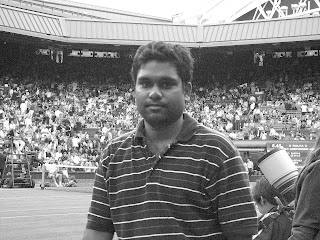
Moi in front of Court No 1


Me with Bhupathi

Anne Keothavong

Mikhail Youzhny

Radek Stepanek

Henman Hill

Mirza and Bhupathi

Alan Wilkins

R Nadal

N Kiefer

Me gracing the center court :)
Nadal at his aggressive best

Victory is sweet - Nadal


I have soaked myself in this great experience and hope this article helps you to get this experience in an easy manner. Contact me if any further details are needed.


m.I.m